
I still remember the first time I took my nose stud out for what I thought would be “just a few hours.” By evening, the jewelry wouldn’t go back in. That tiny hole I assumed was permanent had already started shrinking. It’s surprisingly common for people think that once a nose piercing heals, it stays open forever. The reality is very different.
Nose piercings behave more like living tissue than a fixed hole. They respond quickly when jewelry is removed, especially in the first year. Some close within minutes, others take months, and a few never fully disappear. The timeline depends less on the piercing itself and more on how long your body has adapted to it.
How Nose Piercings Heal and Form a Channel

When you get a nose piercing, the body treats it like a wound. It begins repairing the tissue by creating a thin tunnel called a fistula, essentially a lining of scar tissue around the jewelry. This channel is what keeps the hole stable.
But this tunnel takes time to mature. In the early months, it’s soft and fragile. Remove the stud, and the tissue naturally tries to close, just like any healing skin would. Only after long-term wear does the channel become more permanent and resistant to closure.
How long does it take for a Nose Piercing to Close
Closure speed varies dramatically depending on how old the piercing is. The younger it is, the faster it shrinks.
Here’s a realistic timeline based on healing stages:
- 0–2 months: can start closing within minutes
- 2–6 months: often shrinks within hours or overnight
- 6–12 months: closes in hours to a few days
- 1+ years: days to months; some remain open
Fresh piercings can tighten so quickly that reinserting jewelry even after 10–15 minutes may be difficult. Long-term piercings behave more slowly, but they still shrink once jewelry is removed.
New vs Healed Nose Piercing Closure Time
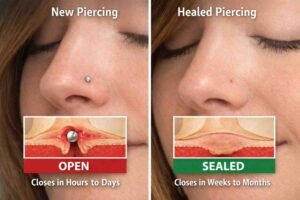
One of the biggest misconceptions is that a “healed” piercing means permanent. Healing and permanence are not the same thing.
A new piercing has an unstable channel. Remove jewelry briefly, and the inner tissue, especially inside the nostril, can seal rapidly.
A well-healed piercing has a mature fistula. It resists closure longer, but without jewelry it still contracts gradually. Even piercings worn for years can narrow enough to make reinsertion uncomfortable.
Very old piercings may never fully close on the surface, but the internal tunnel often shrinks significantly.
Why Nose Piercings Close Faster Than You Expect
Several biological factors make nose piercings prone to quick closure.
Mucous membrane tissue
The inside of the nostril heals faster than normal skin. It can seal internally while the outer opening still looks visible, creating the illusion that the piercing remains open.
Cartilage structure
Nostril piercings pass through cartilage-rich tissue with different blood flow patterns than soft areas like earlobes. This tissue contracts more tightly when jewelry is removed.
Active wound response
The body constantly tries to repair openings. Without jewelry maintaining space, collagen fibers pull inward, shrinking the channel.
Factors That Affect How Fast a Nose Piercing Closes

Closure speed isn’t identical for everyone. Several personal factors influence it.
- How long have you had the piercing
- Individual healing rate
- Skin regeneration speed
- Jewelry thickness and fit
- Scar tissue formation
- Frequency of jewelry removal
Someone with fast tissue repair may see closure sooner than someone with slower healing, even with the same piercing age.
Can a Closed Nose Piercing Be Reopened
If the hole shrinks, it doesn’t always mean it’s permanently gone. Many piercings close in stages.
If the outer opening is still visible, a professional piercer can sometimes guide jewelry back through using a sterile taper. This gently stretches the channel rather than creating a new wound.
If the tissue has fully sealed, re-piercing is usually required. Waiting around 12 weeks allows the tissue to stabilize before piercing again safely.
Forcing jewelry through a closing hole is never recommended. It can cause tearing, infection, or uneven scarring that complicates future piercing.
How to Keep a Nose Piercing From Closing

The simplest rule is consistency. The body only keeps the channel open when jewelry remains in place.
If you need to remove jewelry temporarily, retainers made from clear or biocompatible material can maintain the opening discreetly. Long-term piercings tolerate short removal better, but extended gaps still lead to shrinkage.
Even piercings worn for years benefit from regular jewelry wear if you want them permanently open.
FAQs
1. How fast can a fresh nose piercing close?
A new piercing can begin shrinking within minutes after jewelry removal. Reinsertion may become difficult within an hour.
2. Do nose piercings ever stay open permanently?
Some long-term piercings never fully close on the surface, but the internal channel usually narrows without jewelry.
3. Why does my piercing look open, but jewelry won’t go in?
The inner nostril tissue often seals faster than the outer skin. The surface hole remains visible while the tunnel has closed internally.
4. Can I reopen a nose piercing myself?
No. Attempting to force jewelry through can tear tissue. A professional piercer should assess whether tapering or re-piercing is needed.
Final Thoughts
Nose piercings aren’t static holes; they’re living channels maintained by the presence of jewelry. The younger the piercing, the faster the body tries to reclaim the tissue. What surprises most people is how quickly this happens, sometimes within minutes. Even long-standing piercings aren’t immune. They simply close more slowly, not permanently.
If you want to keep a nose piercing, consistent jewelry wear matters more than age. Once removed long enough, the body almost always begins closing the space.